Aqueous BioPBS Dispersion : Next-Generation Sustainable & Home-Compostable Coating Technology
Aqueous BioPBS dispersion, also known as a water-based or emulsion system, is designed to provide a sustainable coating solution for paper and packaging applications. The technology enables uniform coating formation using conventional coating equipment, delivering effective oil and grease resistance, good heat sealability, and strong adhesion to paper substrates. Transform your packaging with advanced aqueous BioPBS dispersion technology—offering certified compostability and enabling high-performance paper coating applications for the next generation of sustainable packaging.
PTT MCC Biochem Co., Ltd. (PTTMCC) proudly announces the successful development of an innovative aqueous BioPBS dispersion, supporting its strong commitment to sustainable material solutions. BioPBS is increasingly becoming a preferred compostable for sustainable packaging applications. Through dispersion technology, BioPBS can now be applied efficiently as a water-based coating, enabling environmentally friendly barrier solutions without compromising performance.
Aqueous BioPBS Dispersion is a home-compostable coating and film solution designed for manufacturers seeking high-performance, sustainable packaging. It allows paper and other substrates to achieve effective moisture and grease resistance while preserving compostability—delivering an optimal balance between functionality and environmental responsibility. By using BioPBS dispersion, products can achieve a premium appearance while clearly showing their sustainability value, helping brands respond to the growing demand for eco-friendly packaging.
Key Materials – BioPBS
- Primary Compostable Polymer: Acts as the primary film-forming and barrier component
- PBSA-based compostable polymer
- Aqueous Phase
- Water as the continuous phase
- Surfactant System: Used to reduce interfacial tension and stabilize dispersed BioPBS particles
- At least one surfactant selected from:
-
Non-ionic surfactants (e.g., ethoxylated alcohols, ethoxylated fatty alcohols, alkyl polyglucosides, polyoxyethylene-based surfactants)
-
Anionic surfactants (e.g., fatty acid salts, potassium oleate, potassium stearate, sulfonates, sulfates, sodium dodecyl sulfate (SDS), sodium dodecylbenzene sulfonate (SDBS), sodium oleate)
-
- At least one surfactant selected from:
- Polymeric Stabilizer (Optional): Enhances dispersion stability and coating integrity
- Examples include polyvinyl alcohol (PVA), cellulose-based polymers, starch-derived polymers, or combinations thereof
- Functional Additives (Optional): Added in effective amounts to tune processing and end-use performance
- One or more of: plasticizers, antioxidants, pH modifiers, rheology modifiers (polysaccharide-based or synthetic), waxes, tackifiers (rosin-based, terpene-based, or hydrocarbon resins)
- Organic solvents (optional): Examples include ethyl acetate, dichloromethane (DCM), chloroform, and acetone.
Aqueous BioPBS Dispersion Preparation Methods
Aqueous BioPBS dispersion can be prepared using conventional polymer dispersion techniques designed to produce stable, uniform particles suitable for coating applications. Representative preparation methods include the following:
1. The thermo-mechanical dispersion method
BioPBS is mixed with water containing surfactants and additives, then subjected to heat, pressure, and high shear to melt and disperse the polymer. The system is subsequently cooled to solidify the dispersed BioPBS particles, resulting in a stable aqueous dispersion.
2. Solvent displacement method
BioPBS is first dissolved in a suitable organic solvent to form a polymer solution. This solution is then emulsified into water containing surfactants under ultrasonication, agitation, or high-shear homogenization. The organic solvent is subsequently removed by evaporation, forming fine BioPBS particles dispersed in water and yielding a stable aqueous dispersion.
3. Other methods
Other possible approaches include twin-screw extruder dispersion methods and microfluidizer (high-pressure homogenization) dispersion techniques, which utilize intensive shear and pressure to generate fine BioPBS dispersions in aqueous media.
Comparison of Aqueous BioPBS Dispersion Preparation Technologies
|
Aspect |
The thermo-mechanical dispersion method (High-Pressure Reactor) |
Solvent displacement method |
|
Process principle |
Direct dispersion of BioPBS into water using heat, pressure, and shear |
Aqueous BioPBS dispersion via solvent displacement |
|
Solvent requirement |
Substantially solvent-free |
Requires or relies on green organic solvents |
|
Particle formation |
Shear-controlled particle generation for robust dispersion |
Solvent-assisted particle formation |
|
Process complexity |
No solvent handling or removal steps |
Additional solvent recovery/removal steps |
|
Scalability |
Well suited for industrial-scale and continuous processing |
More suitable for laboratory or niche applications |
|
Sustainability advantage |
Lower environmental impact due to minimal solvent use |
Environmental impact depends on solvent selection and management |
.png)
Aqueous BioPBS dispersion preparation process
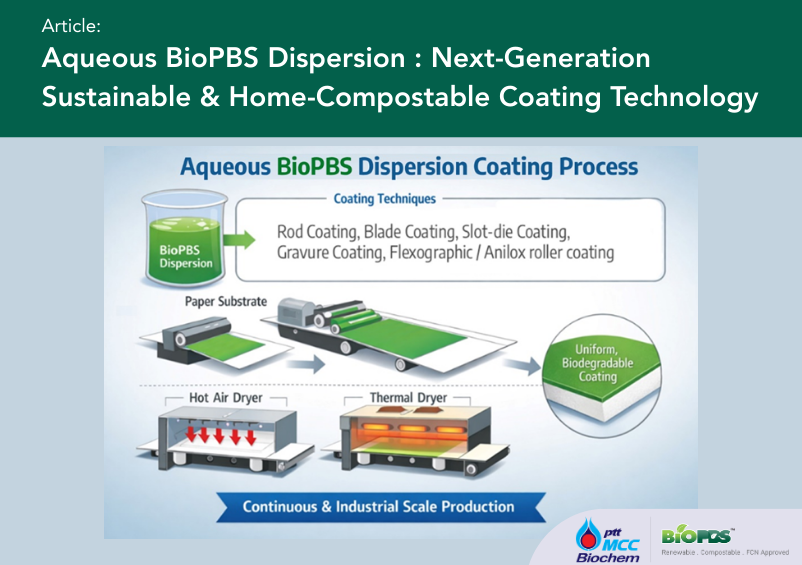
Aqueous BioPBS dispersion coating process
An aqueous BioPBS dispersion is applied to a substrate using conventional coating techniques including flexographic coating, anilox roller coating, gravure coating, or combinations thereof. Alternatively, the dispersion may be applied by rod, blade, or slot-die coating onto paper-based substrates. The coated substrate is subsequently dried at relatively low temperatures using conventional hot-air or thermal drying systems, enabling energy-efficient processing while removing water and forming a continuous, uniform, biodegradable barrier film suitable for industrial-scale production.
.png)
Aqueous BioPBS dispersion coating process
In our study, aqueous BioPBS dispersions with a solid content of approximately 57 wt.% were prepared and characterized, showing a particle size distribution centered around the sub-micron range. These results confirm that the aqueous BioPBS dispersion can generate uniform coatings suitable for paper cup, wrap, and tray applications while maintaining compostability for more sustainable packaging solutions.
.png)
Application Highlights of Aqueous BioPBS dispersions in Food Packaging:
- Biodegradability & Compostability
- Fully biodegradable and suitable for home composting
- Barrier Performance
- Provides effective moisture resistance and grease resistance at low coating weight
- Strong oil and grease barrier (Up to Kit 12) for items like sandwiches, burgers, bakery goods, and fried foods
- Maintains flexibility for easy wrapping and folding
- Film Formation
- Forms a continuous, uniform film upon drying from aqueous dispersion
- Processability
- Compatible with water-based coating processes and standard paper coating machines
- Thin and uniform coating layer, reducing material usage compared to extrusion
- Food Contact Compliance
- Designed to meet food-contact safety requirements (subject to final formulation and regional regulations)
- No migration of harmful substances
- Heat-sealable
- Enables strong seals for cups, wraps, and trays without additional adhesives
Recommended BioPBS™ Grades
- FD92PM, FD72PM, and FD52PM for home compostable applications
Conclusion & Outlook
- Aqueous BioPBS Dispersion provides a scalable, solvent-free, water-based coating solution addressing key performance and sustainability challenges in packaging.
- The thermal–mechanical dispersion approach offers clear advantages in industrial scalability, environmental impact, and process simplicity compared to solvent-based methods.
- Aqueous BioPBS Dispersion enables replacement of conventional plastic and non-compostable coatings while maintaining barrier performance and compostability.
- This technology enables high-performance paper coatings and offers an additional option for biodegradable film applications, supporting the next generation of sustainable packaging solutions.
- Future development will focus on performance optimization, broader substrate compatibility, and collaborative industrial trials to accelerate commercialization across food-service and sustainable packaging markets.
Did You Like This Post? Share it :


BioPBS Story
Home Compostable Paper Coating Using Bio...
22 Apr 2026
Aqueous BioPBS Dispersion : Next-Generat...
18 Feb 2026

Boost Performance and Sustainability wit...
09 Sep 2025
Home compostable development with BioPBS...
01 Apr 2025
Closing the Loop with BioPBS™: Achieving...
09 Feb 2025
Home Compostable Development Solutions...
25 Dec 2024
The Higher Bio-based BioPBS™: A Sustaina...
16 Oct 2024
Metalized BioPBS™ film development – a j...
30 Nov 2022
The time is now! to eliminate “non-eco-f...
31 Aug 2022

Bio-based and Biodegradable Nets for Tur...
31 May 2022
First from Vietnam to the World: Lecka E...
24 Dec 2021
BioPBS in Flexible Packaging: A Composta...
30 Sep 2021
A Single-Use Plastic Plant Nursery Bag T...
30 Jun 2021
Roots – Specialty Coffee Brand Supportin...
30 Mar 2021
Sustainability is the Future: Brand Focu...
29 Dec 2020
Compostable Nonwoven Countering a Surge ...
30 Sep 2020
Bubble Tea on the Rise! Now Served Susta...
21 Apr 2020